

When to Call a Plumber: 5 Common Problems Worth Handing Off
Call a plumber when a problem keeps coming back after the simple fix, when water is where it shouldn't be, or when the cause is hidden inside a wall, a drain line or an appliance. A little hair in a tub drain or a stuck dishwasher filter is a fair DIY job. A sump pump that never shuts off, a water heater that pops and rumbles, or a drain that's slow in more than one spot usually isn't.
Below are five situations homeowners ask about often. For each one, you'll see what you can safely check yourself and the point where a plumber saves you money and mess.
Your dishwasher isn't draining
Standing water at the bottom of the tub after a cycle is one of the most common appliance complaints. Start with the easy checks:
- Remove the bottom rack and clean the filter and the basket under it. Food, glass shards and labels collect here.
- If the dishwasher drains into a garbage disposal, run the disposal. A packed disposal, or a knockout plug that was never removed on a new install, blocks the dishwasher too.
- Check that the drain hose isn't kinked behind or under the unit.
- Run the sink on the other side of the double basin. If that sink is slow as well, the clog is in the kitchen drain, not the dishwasher.
If the filter is clean, the hose is clear and you can hear the pump humming but the water won't leave, stop there. At that point you're looking at a failed drain pump, a blocked drain line, or a problem where the hose connects. Those are worth a professional look, especially since the brand-specific "reset" tricks you'll find online rarely fix a physical blockage.
Your sump pump runs constantly
A sump pump that runs during a heavy rain is doing its job. One that runs nonstop, or cycles every minute or so with no rain, is telling you something is wrong. Common causes include:
- A stuck float switch. The float can wedge against the side of the pit or get tangled in the cord, so the pump never gets the signal to shut off.
- A failed check valve. Water in the discharge pipe drops back into the pit, and the pump has to move the same water again and again.
- A very high water table. After a wet spring or snowmelt, groundwater can keep the pit filling steadily.
- An undersized or worn pump. It runs longer because it can't move enough water per minute.
You can safely look at the pit, make sure the float moves freely, and check that the discharge line outside isn't frozen or blocked. If the float is fine and the pump still won't quit, call someone. A pump that runs around the clock wears out faster, and it will often fail during the next big storm, when you need it most. If your basement is finished, that's a costly gamble.
Your bathtub drains slowly
A slow tub is almost always hair and soap scum catching on the stopper or just below it. Pull the stopper, clean it, and use a plastic drain tool or a hand snake to pull out what's in the first stretch of pipe. That fixes most slow tubs.
Skip the chemical drain cleaners. They can sit in a tub that's already full of standing water, they're hard on older pipes, and they're unpleasant for whoever has to work on the drain next.
Call a plumber if:
- The tub is still slow after you've cleaned the stopper and snaked the drain.
- The toilet gurgles when the tub drains, or the shower and a nearby sink are slow too. That points to a clog farther down the line, possibly the main sewer line.
- Water backs up into the tub when you run the washing machine.
When a blockage is deep in the system, a video camera inspection shows what's actually in the line, whether that's grease, roots or a collapsed section, so you aren't guessing.
Your faucet won't stop dripping
A drip is usually a worn washer, O-ring or cartridge inside the faucet. It's tempting to ignore, but a steady drip wastes water, stains the sink, and tends to get worse as the worn part scrubs against the valve seat.
Replacing a washer or cartridge is a reasonable DIY project if you can shut off the water at the fixture's own valves and the faucet comes apart without a fight. Take the old part to the store so you buy the right match, because faucet parts aren't interchangeable.
It's time for a plumber when:
- The shutoff valves under the sink are stuck, corroded or don't fully stop the flow.
- The faucet is old, pitted or crusted with mineral buildup and the parts won't come loose.
- Water is leaking from the base of the faucet or underneath the sink, not just from the spout.
- You've replaced the cartridge or washer and it still drips. The valve seat may be damaged, and replacing the whole faucet is often the better fix.
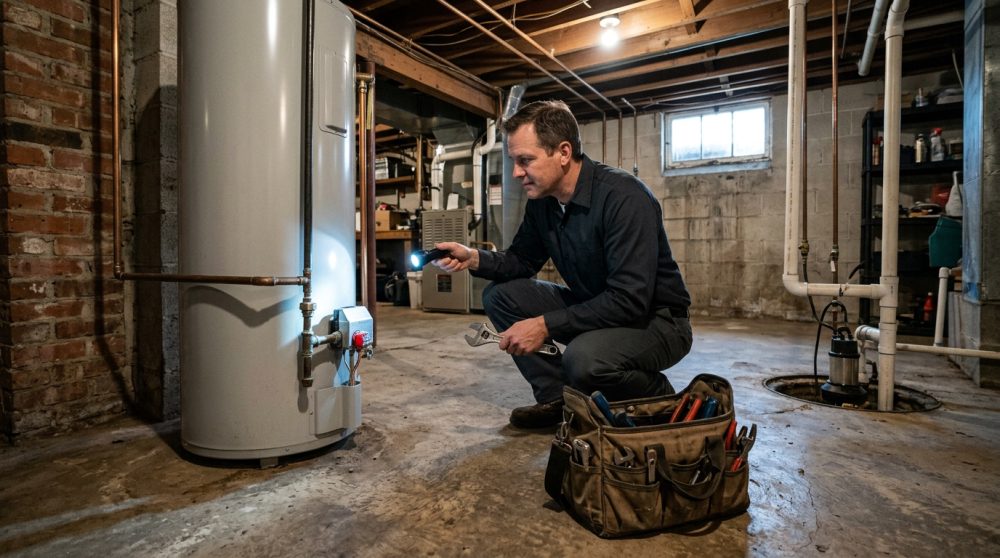
Your water heater is making noise
Popping, rumbling or knocking from a tank water heater usually means sediment has settled on the bottom. Water gets trapped under the layer, boils, and bubbles through. Hissing or sizzling can mean sediment too, or a small leak dripping onto a hot surface. A high-pitched whistle can point to a partly closed valve or scale on a heating element.
Draining a few gallons from the tank can help with early sediment, but heavy buildup that has hardened won't flush out easily. It makes the heater work harder, raises your energy use and shortens its life. Call a plumber if you see any of the following:
- Noise that gets louder or doesn't improve after a flush.
- Water pooling around the base of the tank.
- Rusty or discolored hot water.
- Not enough hot water, or water that runs hot and cold.
If you have a gas heater and smell gas, leave the house and call your gas utility first. That one isn't a plumbing-call-in-the-morning situation.
A quick guide: fix it yourself or call
| Problem | Reasonable to try yourself | Call a plumber when |
|---|---|---|
| Dishwasher won't drain | Clean filter, check hose, run disposal | Pump hums but water stays, or the drain line is blocked |
| Sump pump runs constantly | Check float and discharge line | It still won't shut off, or it's running with no rain |
| Slow tub drain | Clean stopper, snake the drain | Other fixtures are slow or gurgle |
| Dripping faucet | Replace washer, O-ring or cartridge | Shutoffs fail, base leaks, or the drip returns |
| Noisy water heater | Partial tank flush | Noise persists, leaks, rusty water |
The pattern behind all five
In every one of these, the symptom is easy to see and the cause often isn't. Clearing a clog or swapping a part can hide the real issue for a few weeks. That's why the goal should be a fix that lasts, not a band-aid.
At Geer Plumbing Solutions, we work from what we call the trust triangle: the skill to diagnose and repair the problem, the communication to explain what we found and why, and the integrity to recommend only the right work. We take the time to walk you through each job and our thinking behind it, and we show up when we say we will. We're licensed and insured, and we handle dishwashers, faucets, sump pumps, water heaters, tubs and showers, and sewer lines across Tuscarawas County. If one of these problems sounds familiar, you can reach us at 330-432-8073.
Frequently asked questions
Can you put Drano in a dishwasher to unclog it?
It's best not to. Chemical drain cleaners can damage rubber seals, hoses and plastic parts, and the caustic liquid can sit in the tub and splash back on you. Most dishwasher clogs are in the filter, drain hose, disposal connection or pump, which a chemical can't clear anyway.
Is it bad for a sump pump to run continuously?
Yes, if it isn't a response to heavy rain or snowmelt. Constant running wears the motor, and a pump that never rests is more likely to fail when the next storm arrives. If it runs nonstop in dry weather, find out why before it burns out.
Is it normal for a sump pump to run every 30 seconds?
During a downpour, it can be. If it's cycling that often with little or no rain, suspect a failed check valve, a sticking float, or a pump that's too small for the pit. Either way, the pattern deserves a closer look.
Can I fix a dripping faucet myself?
Often, yes. Shut off the water at the fixture, take the handle apart, and replace the worn washer, O-ring or cartridge. If the shutoff valves don't hold, the parts are corroded, or the faucet still drips after the repair, a plumber can find the underlying problem or replace the faucet.