

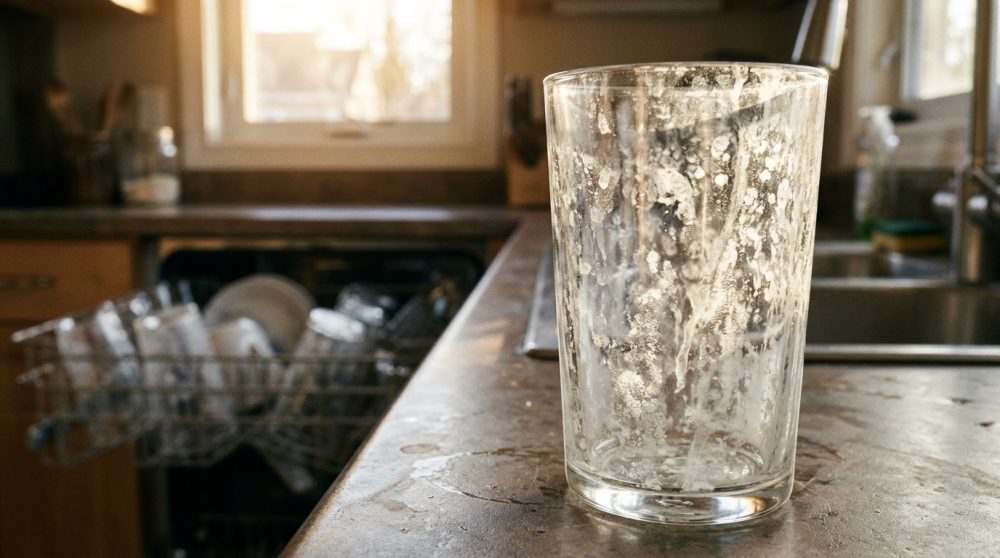
If your water leaves spots on glassware, a crust on the faucet, and soap that never quite rinses off, you're almost certainly dealing with hard water. It's well documented across Tuscarawas County, and it's a mineral problem rather than a safety problem. Water conditioning is the set of tools that deal with it, and picking the right one starts with knowing what's actually in your water.
The short version: a test tells you how hard your water is, a softener handles hardness, and a carbon filter handles taste and odor. Those are different jobs, and one device rarely does both well. The rest of this article helps you sort out which one you need.
What hard water looks like around the house
Hard water carries dissolved calcium and magnesium. You don't taste it so much as see and feel it. Common signs include:
- White, chalky buildup on faucets, showerheads, and glass shower doors
- Spots on dishes and glasses that come out of the dishwasher
- Soap and shampoo that don't lather well
- Dry-feeling skin and hair after showering
- Laundry that feels stiff or looks dull
- Scale inside kettles, and slower hot water over time as it builds up inside water heaters
That last one matters for your wallet. Scale insulates the heating surfaces in a water heater, so the appliance works harder to deliver the same hot water. Fixtures, dishwashers, and washing machines pick up scale too.
How to find out how hard your water really is
Don't guess. Hardness is measured in grains per gallon (gpg) or milligrams per liter (mg/L). A commonly used scale looks like this:
| Classification | Grains per gallon |
|---|---|
| Soft | Under 1 |
| Slightly hard | 1 to 3.5 |
| Moderately hard | 3.5 to 7 |
| Hard | 7 to 10.5 |
| Very hard | Over 10.5 |
You have a few ways to get your number:
- Your water utility's report. If you're on a municipal system, the annual water quality report usually lists hardness. It's free, and it's a good starting point.
- Test strips or a titration kit. Strips from a hardware store give a quick reading in a minute or two. A drop-count kit is a bit more precise.
- The soap shake test. Put a little pure liquid soap and tap water in a clear bottle and shake it. Lots of suds with clear water suggests soft water. Few suds and cloudy water suggests hard. It's rough, but it tells you something.
- A lab test. This is the better route if you're on a private well, since well water can vary a lot from one property to the next and can carry other problems, like iron, that strips don't catch.
Test at a tap that hasn't passed through any existing treatment. If you already own a softener, test both the incoming water and the softened water so you know whether it's doing its job.
Match the treatment to the problem
"Water conditioning" gets used loosely, so here's a plain way to think about it. Start with what's bothering you, then pick the tool built for that.
| What you're seeing | What usually addresses it |
|---|---|
| Scale, spotting, dry skin, soap that won't lather | A water softener, which removes the hardness minerals |
| Chlorine taste or smell | An activated carbon filter |
| Sediment, grit, or cloudy water | A sediment filter |
| Dissolved solids or certain contaminants in your drinking water | A reverse osmosis system at the kitchen sink, chosen based on a test result |
| Hardness plus taste or odor concerns | A softener paired with a carbon filter |
The mistake we see people worry about most is buying a filter to fix a hardness problem. A standard carbon filter doesn't remove calcium and magnesium, so the scale stays. Likewise, a softener won't improve chlorine taste on its own.
Where reverse osmosis fits
Reverse osmosis pushes water through a very fine membrane, which removes a wide range of dissolved substances. It's typically installed under the kitchen sink for drinking and cooking water rather than for the whole house. It's a good choice when a water test points to something specific you want out of your drinking water. It isn't a substitute for a softener, and it isn't something to buy before you know what you're trying to remove.
Frequently asked questions
What type of water softener is best?
The best one is the one sized and set up for your actual water and household. A softener that uses salt and resin is the standard approach for removing hardness. The things that matter most are your measured hardness, how many people live in the home, and how much water you use. Brand matters less than correct sizing and a sensible setup.
Can you buy too big of a water softener?
Yes. An oversized unit can sit for long stretches between regenerations, which isn't ideal for the resin, and it costs more up front for capacity you won't use. An undersized one runs out and regenerates constantly. Sizing from your hardness number and household water use avoids both problems.
Can activated carbon be used to treat drinking water?
Yes. Activated carbon is widely used to reduce chlorine taste and odor, and it can reduce some other contaminants depending on the filter. What it doesn't do is remove hardness minerals. Check what a specific filter is certified to reduce, and match that to what your water test shows.
What is the healthiest type of water filter?
There isn't one winner. The best choice is the filter that removes what's actually in your water. Test first, then choose. A carbon filter, a sediment filter, or a reverse osmosis system can each be the right answer depending on the result. Whichever you pick, replace the filters on schedule, because an overdue cartridge stops doing its job.
Getting a plan that fits your house
Geer Plumbing Solutions installs water softeners and water filters for homes across Tuscarawas County. We like to explain what your water needs and why before recommending anything, so you understand the choice. If you'd like to talk it through, call 330-432-8073 on a weekday between 8 am and 5 pm.